
Curly hair grows in tight spirals. This helical shape creates points of fragility at each bend of the shaft, where the scalp’s sebum struggles to travel down. The fiber is therefore structurally drier and more vulnerable to breakage than other hair types. Understanding this mechanism allows for the adjustment of care routines and the distinction between a benign issue and a situation that requires medical advice.
Breakage along the shaft or loss at the follicle: two distinct hair problems
When finding hair on the pillow or in the comb, the reflex is to talk about “shedding.” However, the distinction between breakage along the shaft and loss originating from the follicle changes everything: the causes, severity, and response required are not the same.
A broken hair has an irregular, sometimes frayed end. It breaks at a point of mechanical weakness, often in the middle of the shaft or near the tips. The length decreases, but the follicle remains intact and continues to produce a new hair.
A hair that has fallen out with its bulb (the small white sheath visible at the end) indicates follicular loss. When this loss exceeds normal renewal, concentrates in certain areas, or is accompanied by scalp pain, it may indicate traction alopecia or another form of pathological shedding. The American Academy of Dermatology (AAD) associates repeated traction from tight hairstyles with alopecia that can become permanent if the follicles are damaged.
To prevent the shedding of curly hair, one must first understand what is being observed: broken shaft pieces call for an adjustment in the care routine, while bulb loss concentrated on the temples, hairline, or crown warrants a quick dermatological consultation.

Warning signs: when to stop self-diagnosing curly hair
Adapting one’s hair care routine corrects most breakage problems. However, some signals indicate that the issue goes beyond home care.
Scalp pain during or after styling
A sensation of pulling when putting in braids, locks, or a weave is not normal. Pain during the application of a hairstyle is a warning sign, not evidence that the style “holds well.” The AAD recommends immediately loosening any painful hairstyle and varying styles to limit traction on the same areas.
Thinning areas or bald patches
Thinning temples, a receding hairline, or smooth patches on the scalp indicate follicular damage. The AAD states that several forms of hair loss require dermatological evaluation and that early consultation improves regrowth chances.
Hair that no longer grows in a specific area
When a follicle is destroyed by prolonged traction or chronic inflammation, regrowth stops permanently in that area. This is the difference between reversible traction alopecia (if caught in time) and a scarring form (irreversible).
Hydration and nutrition: the foundation of resilient curly hair
Mechanical breakage remains the most common problem with curly hair. The tight spiral of the fiber prevents the natural distribution of sebum: without external moisture, curly hair dehydrates within days.
Hydration relies on water, not just oil. Properly hydrated hair is supple, elastic, and better withstands manipulation. Nutrition (lipid intake) then seals this hydration within the fiber.
- Spray hair with water or a water-based treatment before applying any oil or butter, so that the lipid body retains water in the fiber rather than sitting on dry hair
- Favor vegetable oils (avocado, castor, jojoba) and butters (shea, mango) over mineral oils, which form an occlusive film without nourishing the fiber
- Check the composition of the shampoo: harsh sulfates strip away the little natural sebum present on curly hair and worsen dryness between washes
- Apply a deep moisturizing mask once a week, focusing on lengths and ends where dryness is most pronounced
Protective hairstyles and extensions: traps to be aware of
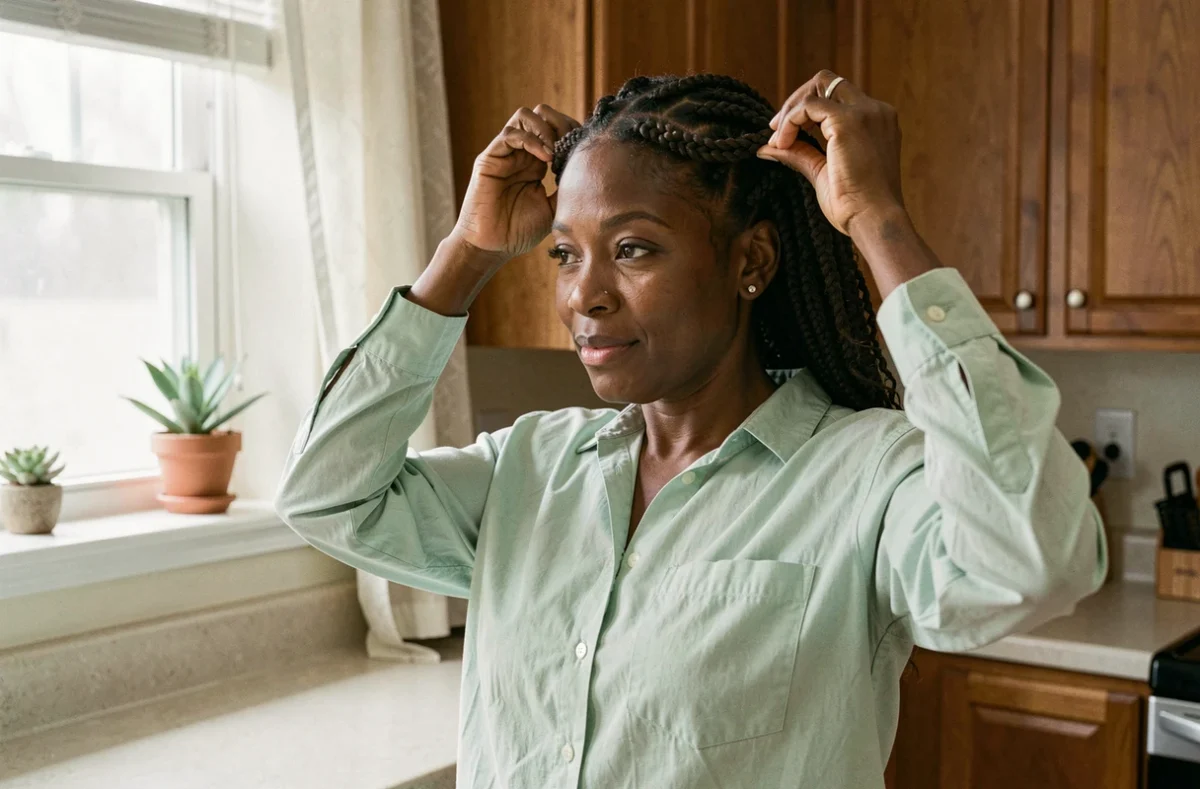
Protective hairstyles (braids, twists, bantu knots) reduce daily manipulation and limit mechanical breakage. Their benefit is based on a simple principle: the less the hair is touched, the less it breaks.
The trap comes from excess. Too-tight braids or those worn too long reverse the benefit by exerting constant traction on the follicle. The AAD recommends taking breaks between protective styles and never neglecting the washing and care of hair under extensions.
Some concrete guidelines to limit damage:
- If the hairstyle causes headaches or visible tension on the scalp skin, it is too tight
- Extensions and weaves must allow access to the scalp for cleaning and hydration; otherwise, residues accumulate and weaken the follicles
- Alternating traction areas from one hairstyle to another protects the follicles at the temples and hairline, which are most exposed to traction alopecia
Smoothing chemical treatments: an often underestimated factor of fragility
Relaxers and chemical straighteners alter the internal structure of the fiber by breaking the disulfide bonds that give it its spiral shape. Each chemical treatment weakens the hair shaft permanently. The layering of a relaxer and a color treatment, or applying it to already weakened hair, multiplies the risk of severe breakage.
Spacing out treatments, never applying a smoothing product to an irritated scalp, and testing the strength of a strand before any full application are basic precautions that many salons neglect.
The fragility caused by a chemical treatment cannot be corrected by a simple moisturizing treatment. The portion of the shaft that has already been altered remains permanently more brittle, and only natural regrowth will restore an intact fiber in that area.
The choice between maintaining the natural curly texture and resorting to chemical smoothing is not trivial. For hair that is already breaking or showing signs of follicular loss, temporarily giving up chemical treatments remains the most protective measure even before investing in new care products.