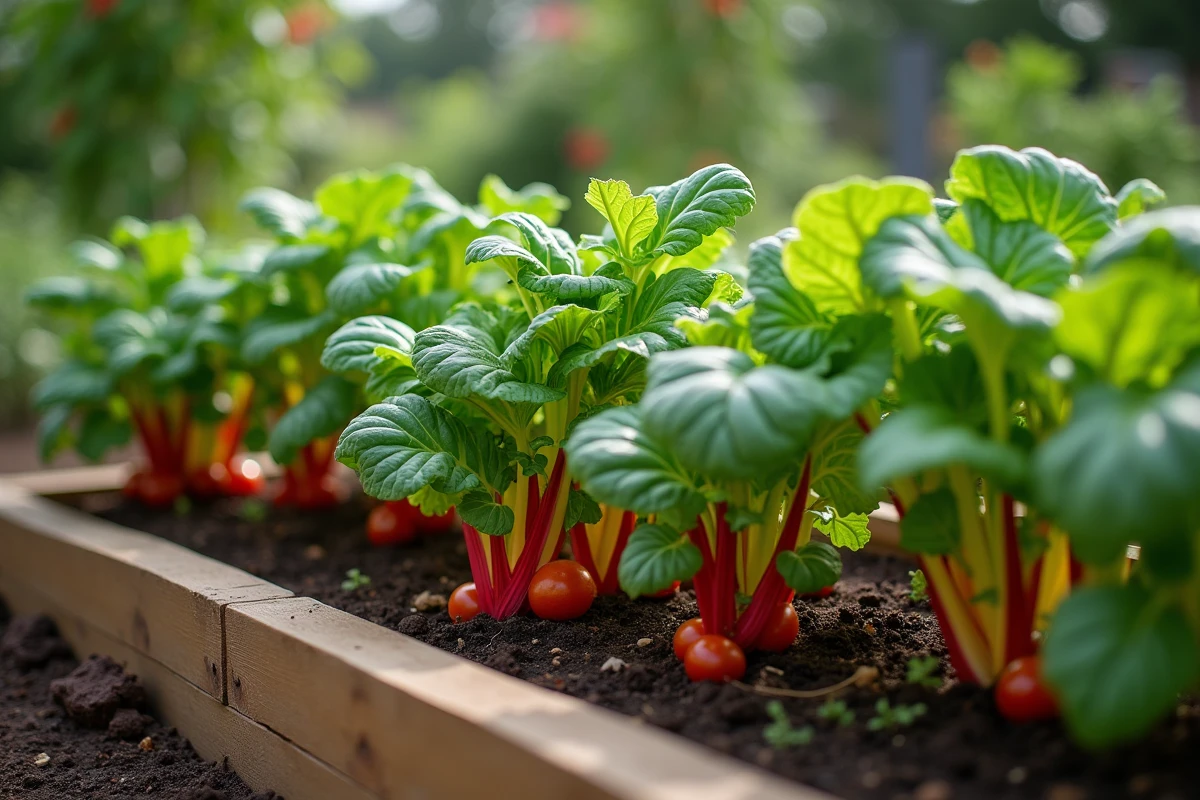
Swiss chard and tomato share a common requirement for rich soil, but their root systems and absorption dynamics do not operate on the same timelines. It is precisely this discrepancy that makes their association in the vegetable garden relevant, provided that a few technical parameters often overlooked in traditional companion planting tables are mastered.
Swiss chard and tomato: managing the water conflict between two plants with opposing needs
The tomato fears stagnant moisture at the collar and on the foliage, a favorable ground for downy mildew and alternaria. Swiss chard, on the other hand, tolerates a cool and regularly moist soil well. Growing these two species side by side requires differentiating watering zones or precisely adjusting the schedule.
We recommend morning watering at the base, never by spraying. In the morning, the water absorbed by the Swiss chard at the surface does not have time to maintain prolonged moisture around the tomato stems. A differentiated mulch reinforces this management: thick straw at the base of the tomatoes to limit evaporation without saturating, and finer mulch on the Swiss chard side to retain the coolness they appreciate.
Spacing also plays a direct role. Allowing at least forty centimeters between the tomato plants and the rows of Swiss chard avoids immediate root competition and allows air circulation, which reduces fungal pressure on the tomatoes.
To delve deeper into the topic of swiss chard and tomato association in the vegetable garden, understanding the specific needs of each species remains the most reliable starting point before any implementation in the garden.

Swiss chard as a nitrogen buffer on a tomato bed
The tomato is a very greedy fruit-vegetable. It heavily draws from the soil’s reserves, particularly nitrogen and potassium. At the end of the cycle, the soil of a tomato bed is often depleted, which poses a problem for the next crop.
Swiss chard utilizes residual nitrogen without further depleting the soil. It is a leafy vegetable with moderate needs compared to the tomato, capable of utilizing nitrogen leftovers where a new fruit-vegetable would fail. This “buffer” function is documented in recent crop rotation approaches, where Swiss chard is interspersed after or alongside tomatoes to stabilize the fertility of the plot.
In practice, two scenarios work well:
- The simultaneous intercropping, where Swiss chard occupies the space between the staked tomato rows, benefiting from partial shade in summer to avoid premature bolting.
- The succession on the same bed, by sowing Swiss chard as soon as the tomato plants are pulled up at the end of the season, to capture the remaining nitrogen before winter.
- The reversed spring relay: Swiss chard planted early in the season frees up space for tomatoes transplanted later, with the organic matter from the cut leaves serving as surface mulch.
In each case, Swiss chard acts as a fertility regulator rather than just a neutral neighbor. This functional role goes beyond traditional companionship based solely on compatibility.
Planting distances and light management in the vegetable garden
The staked tomato can reach a significant height, creating an exploitable shaded area. Swiss chard, unlike many leafy vegetables, tolerates reduced light during part of the day. We even observe a direct benefit: the shade from the tomatoes delays the bolting of Swiss chard in the height of summer.
The orientation of the rows conditions the outcome. By placing the tomatoes to the north of the bed (in the northern hemisphere), their shade falls on the Swiss chard located to the south only at the end of the day, when thermal stress is at its maximum. This positioning protects the Swiss chard without depriving the tomatoes of their full morning sunlight.
Density and spacing to respect
The temptation to crowd the plants to maximize space is the main pitfall of this association. Too high a density leads to root competition and favors fungal diseases in both species.
We recommend maintaining the usual spacing for tomatoes (depending on the growth habit of the variety) and interspersing the Swiss chard in the gaps rather than on the row itself. One Swiss chard plant every thirty centimeters in the gap leaves enough room for pruning, harvesting, and air circulation.
Rotation and planning over multiple seasons
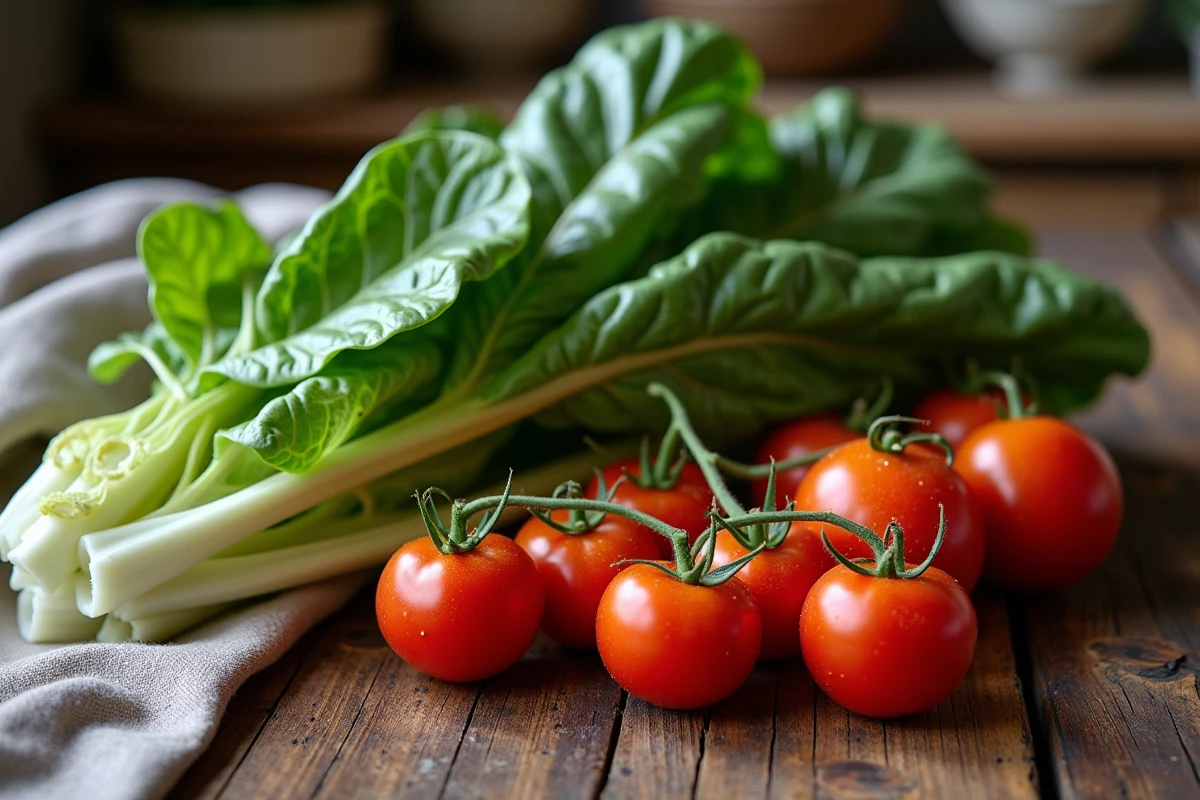
Associating Swiss chard and tomato one year does not exempt you from considering rotation. Tomatoes should not return to the same plot for several seasons to limit the pressure from soil pathogens (verticillium wilt, fusarium wilt). Swiss chard, belonging to the Chenopodiaceae family, shares no common diseases with the Solanaceae, making it a rotation companion without cross-health risks.
However, do not follow Swiss chard with beet or spinach in the same bed the following year: these species belong to the same family and share pests (beet fly, cercospora). The benefit of rotation disappears if you remain within the same botanical family.
Which vegetables to avoid near this association
Other Solanaceae (potato, eggplant, pepper) should not be placed immediately next to tomatoes, for the usual health reasons. On the Swiss chard side, keep cabbages away as they attract the same aphids and compete for available nitrogen.
Legumes (beans, peas), on the other hand, make excellent border neighbors: their atmospheric nitrogen fixation partially compensates for the tomato’s uptake and indirectly benefits the Swiss chard.
The success of this association relies less on a fixed compatibility chart than on observing one’s own soil, local climate, and actual pest pressure. Adapting spacings, monitoring watering, and planning rotation over a minimum of three years yields much more reliable results than a theoretical scheme applied without adjustment.