
Your phone suggests the end of your sentences, your watch detects an abnormal heart rate, and your car brakes before you see the obstacle. Behind these daily gestures, technological layers evolve at a pace that makes each quarter different from the last. Understanding current tech trends is less about following a catalog of new products and more about spotting the underlying movements that change how we work, consume, and protect our data.
European AI Act: the regulation redefining the development of artificial intelligence
Have you noticed that generative AI tools increasingly display mentions like “content generated by AI”? This is not a marketing choice. It is a direct consequence of the European regulation on artificial intelligence, adopted in 2024, whose obligations apply progressively.
Specifically, this text classifies AI systems by risk levels. A public chatbot does not fall into the same category as an algorithm that sorts applications or allocates bank credits. High-risk systems must document their training data and ensure human oversight.
For companies, this changes the game right from the design of a product. A software publisher integrating AI into its recruitment tool must plan, even before market launch, a compliant technical file. This framework encourages teams to integrate regulatory compliance on par with technical performance from the very first lines of code.
To keep track of these developments over time, you can access the tech section of MaxiScoop, which regularly covers news about new technologies and their legal framework.
Governance of AI assistants in companies: beyond automation
Installing an AI assistant in a team is a bit like hiring an ultra-fast intern but without a filter. It produces quickly, but it can also invent sources, mix confidential data with public queries, or formulate legally risky responses.
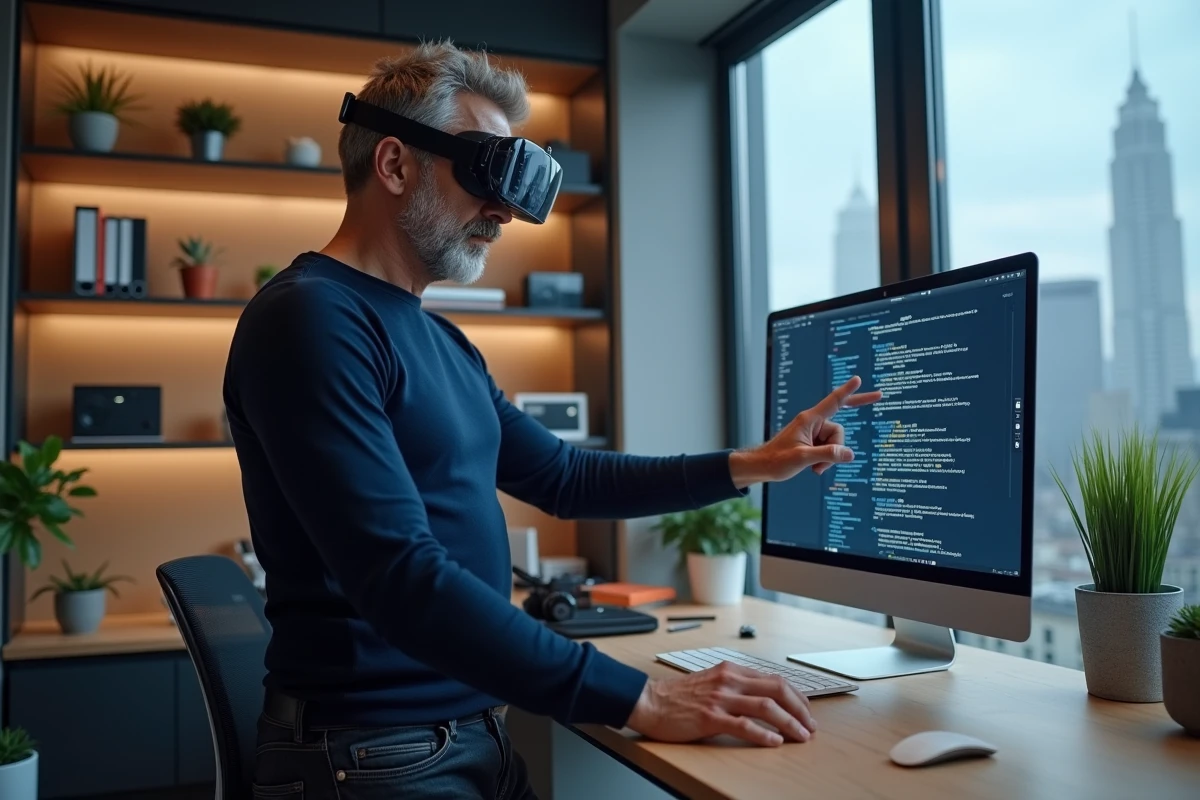
The most advanced companies no longer just deploy these tools. They implement usage policies that precisely define what types of documents can be submitted to an assistant, which sources it is allowed to consult, and how to trace the origin of each response.
The traceability of AI responses is becoming an information governance issue. A law firm using an assistant to summarize case law needs to verify each cited reference. A marketing team generating visuals must ensure that no copyrighted elements are reproduced.
This maturation transforms the role of IT departments. They no longer just manage the technical infrastructure but also arbitrate authorized uses, train employees, and audit the results produced by these systems.
Energy consumption of AI and sustainable tech: the real underlying debate
Why talk about energy in an article on tech trends? Because training a large AI model consumes as much electricity as a small town for several weeks. And this cost is not decreasing: each new generation of models is more power-hungry than the previous one.
The debate on sustainable tech has changed in nature. It is no longer just about recycling smartphone components or reducing the carbon footprint of a data center. The question now concerns the balance between the benefit of an AI service and the energy it requires.
- Cloud providers are investing in renewable energy sources to power their data centers, but demand is growing faster than the available green supply.
- Optimization techniques like “model distillation” allow for the creation of lighter versions of an AI, capable of running on less powerful hardware with reduced consumption.
- Some companies are beginning to integrate an “AI carbon budget” into their projects, just like a financial budget, to balance performance and sobriety.

This topic remains largely underestimated in the digital strategies of SMEs. Asking about the energy footprint of a tool before adopting it is becoming an increasingly relevant reflex.
Post-quantum cryptography: preparing data security before the threat
Quantum computing is one of those topics that has been mentioned for years without always understanding how it concerns us. Here’s the simple idea: quantum computers, when they reach sufficient power, will be able to break most current encryption systems. Your passwords, your bank transactions, your encrypted professional exchanges would become readable.
Post-quantum cryptography involves developing algorithms resistant to this future computing power. This is not science fiction: standards are already being published, and some large companies are starting to migrate their systems.
The most concrete risk has a technical name: “harvest now, decrypt later.” Malicious actors are currently collecting encrypted data in the hope of decrypting it later when quantum technology allows it. For organizations handling sensitive data (health, defense, finance), anticipating this transition is a security investment, not a theoretical expense.
Spatial computing and mixed reality: when the digital overlaps with the real
You know virtual reality, that headset that cuts you off from the outside world. Spatial computing works the opposite way: it overlays digital elements onto your real environment without isolating you.
A maintenance technician can see repair instructions projected directly onto the machine he is inspecting. An architect can visualize a building to scale, planted in the actual terrain, before the first bulldozer. These uses go beyond gimmicks because they reduce training time and error rates.
- In industry, mixed reality accelerates quality control processes by visually guiding the operator step by step.
- In medical training, students manipulate three-dimensional anatomical models without needing a cadaver or specialized mannequin.
- In retail, some brands already allow you to visualize a piece of furniture in your home before purchase, with accurate dimensions.
The main barrier remains the cost of equipment and the maturity of applications. But industrial use cases are already generating measurable returns on investment, which accelerates adoption beyond the general public.
The technological trends that matter are not those that make the most noise, but those that sustainably change a process, a legal framework, or a business model. The AI Act reshapes the rules of software development in Europe, AI governance restructures organizations from within, and the energy question imposes a trade-off that no one will be able to avoid for long. Keeping an eye on these underlying movements is what separates useful monitoring from a mere parade of novelties.