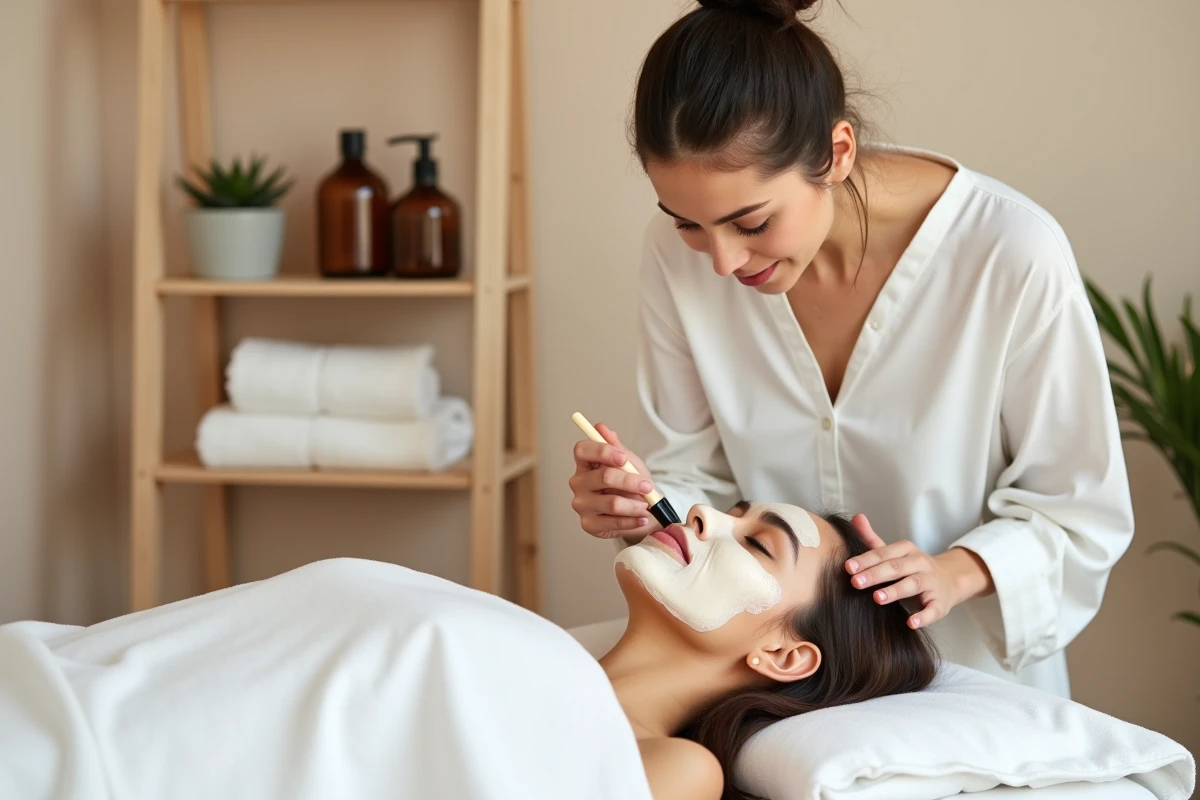
The craft code regulates aesthetic treatments through a requirement for professional qualification. Article L. 121-1 establishes the principle: aesthetic treatments can only be performed by a qualified person or under their effective and permanent control. The difficulty lies in what the notion of “aesthetic treatments” encompasses, as there is no legal or regulatory definition that sets the exact scope.
This legal ambiguity opens up space for certain beauty services that do not formally fall under aesthetic treatments as defined by the code. Understanding where this boundary lies allows one to know what is accessible without an aesthetic CAP, and what is not.
Regulated aesthetic treatments: the framework established by the craft code
The legal foundation is based on the craft code. Any service classified as an aesthetic treatment requires a diploma (CAP, BP, BTS in aesthetics-cosmetics-perfumery) or the direct supervision of a qualified professional. The control must be “effective and permanent,” which excludes mere occasional presence in the premises.
Parliamentary question no. 6076 of the 17th legislature highlights the issue: the emergence of new technologies has gradually blurred the line between aesthetics and aesthetic medicine. The legislator has not yet updated the texts to cover all recent techniques, placing some professionals in a zone of legal uncertainty.
A comprehensive guide on services without an aesthetic CAP details this distinction between regulated acts and free activities.
In practice, the following acts are associated with regulated aesthetic treatments:
- Hair removal (waxing, tweezing, threading, sugaring), considered a classic aesthetic treatment requiring a CAP
- Facial and skin treatments for aesthetic purposes (cleansing, scrubbing, facial massage)
- Aesthetic manicure and pedicure, which involve work on the skin and nails

Beauty services without a diploma: the distinction between aesthetic treatment and service
The key to understanding lies in the nature of the service. A beauty service does not constitute an aesthetic treatment in the sense of the craft code, provided it does not involve invasive contact with the skin or modification of its characteristics.
Makeup is the most common example. Applying cosmetic products to healthy skin for a temporary effect falls under beauty services, not treatment. Similarly, nail prosthetics (application of false nails, gel, resin) are not classified as aesthetic treatments as long as they do not involve work on the peripheral skin or cutting of cuticles.
Image consulting, makeovers, or the sale of cosmetic products do not require aesthetic qualification. These activities can be carried out under the status of self-employed or in a company without specific diploma requirements.
Limits not to be crossed
The boundary remains fragile. As soon as a service touches the integrity of the skin (removal of dead cells, extraction of comedones, application of penetrating active products), it shifts to the side of regulated aesthetic treatments. The technique used determines the classification, not the commercial name of the service.
Renaming a facial treatment as a “wellness ritual” does not change its legal nature. A control by the DGCCRF or the chamber of trades is based on the action performed, not on the title of the menu.
Laser hair removal and intense pulsed light: the May 2024 decree changes the game
Laser and intense pulsed light hair removal historically fell under medical monopoly. The decree no. 2024-470 of May 24, 2024 has changed this situation by opening the practice to state-certified nurses, without a prescription or the presence of a doctor.
This reform concerns non-therapeutic hair removal. The nurse must meet two conditions: complete a mandatory “basic laser training” (defined by the order of February 19, 2025) and use a CE-marked medical device. A written information sheet must be provided to the client before the first session.
This decree creates a pathway for laser hair removal services for healthcare professionals without an aesthetic diploma. For qualified aestheticians, laser hair removal remains prohibited unless there is subsequent regulatory evolution. Laser and intense pulsed light are not services open without a diploma: they are simply redistributed among healthcare professionals and doctors.
Traceability obligations related to the decree
The decree introduces obligations comparable to those of medical care acts:
- Exclusive use of a laser or intense pulsed light device bearing the CE marking as a medical device
- Provision of a written information sheet detailing risks, contraindications, and the course of the session
- Maintenance of a follow-up file for each client, ensuring traceability of the sessions performed
Practicing under the supervision of a graduate: real conditions in institutes and salons
The craft code allows a non-graduate to perform aesthetic treatments if they work under the effective and permanent control of a qualified professional. This wording has direct practical consequences on the organization of an institute or beauty salon.
The qualified professional must be physically present in the establishment during the performance of the treatments. Remote supervision, by phone or video conference, does not satisfy the legal requirement. For a salon employing several non-graduate practitioners, theoretically, one qualified reference present at all times is sufficient, but the burden of actual control may raise questions during an administrative inspection.

This option allows an entrepreneur without a CAP to open an institute provided they hire a qualified employee who ensures supervision. The model is legally valid but economically constraining, as it requires a permanent qualified position from the outset.
The distinction between artisanal and commercial activity also comes into play: a beauty institute is classified as artisanal up to ten employees, then commercial beyond that. In both cases, the qualification requirement remains the same. Professional liability insurance covers acts performed under supervision, but the policy must explicitly mention this configuration to avoid a refusal of coverage in case of a dispute.